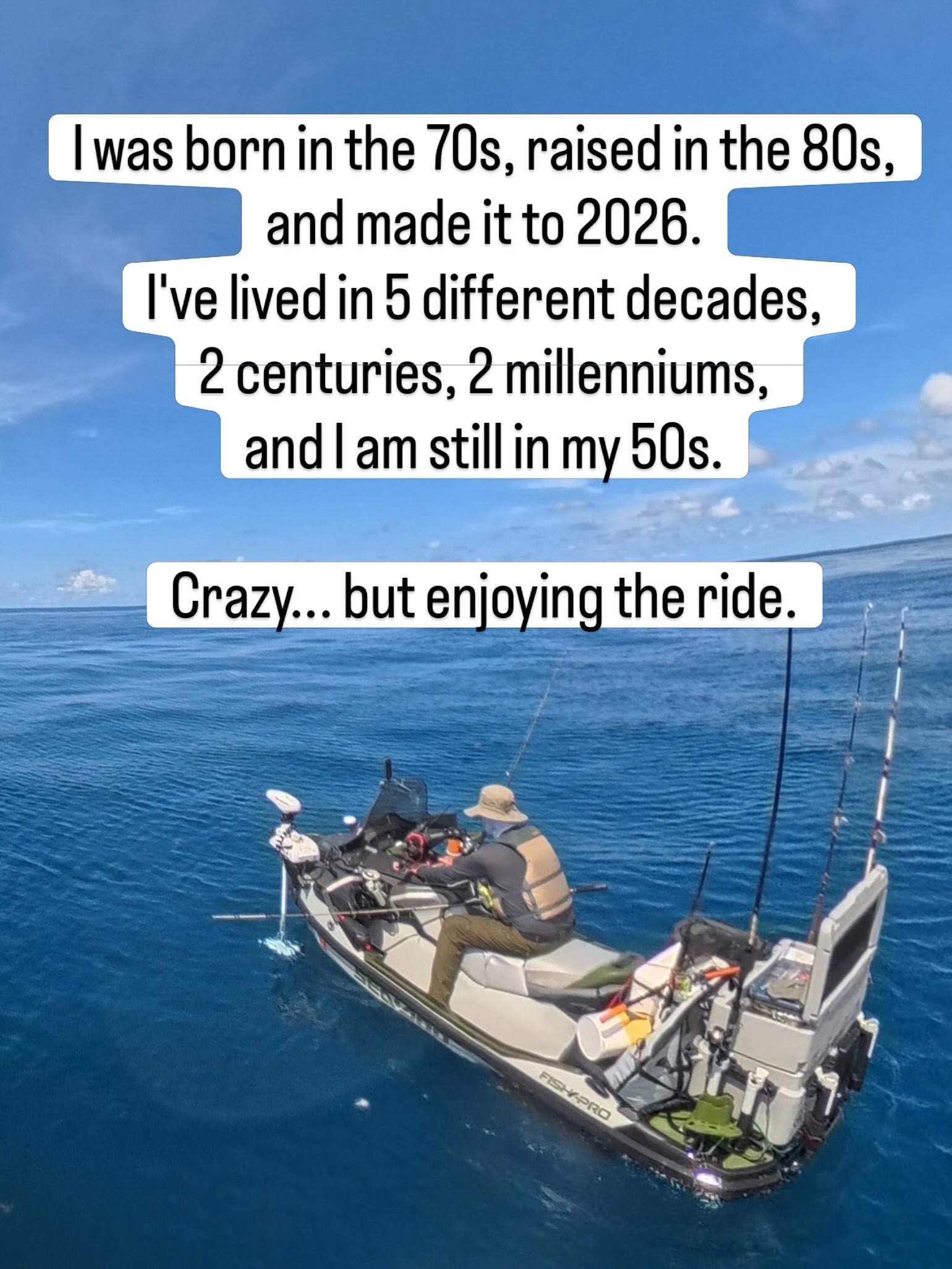
A deep-sea fishing day — out on the water.
I was born in the 70s, raised in the 80s, and I've now worked across five decades, two centuries, two millenniums. I'm still in my 50s, and I'm still shipping. The reason isn't that I kept up with everything. It's that I got good at deciding what was worth keeping up with.
That's the part nobody tells you about a long tech career. The field doesn't reward the person who learns every new thing. It rewards the person who can look at a new thing and correctly decide: this is a wave, or this is noise.
/ The Technologies Come and Go
Think about what's changed just in my working life. Floppy disks gave way to hard drives, then to the cloud. Desktop apps became web apps became mobile apps. Mainframes, client-server, SOA, microservices. Every few years, the hot new thing arrived with the same pitch: this is the future, learn it or be left behind.
Most of them were right. And most of them are gone now.
The people who built a career by mastering any single one of those — the framework, the language, the platform — had to rebuild every time the wave moved. The people who lasted are the ones who learned something portable instead: how to think about a system, how to make a decision under uncertainty, how to lead people through change. Those don't go stale.
/ The Trap Is Treating Every New Thing as Equal
The hardest part of a long career isn't the learning. It's the triage. Every week there's a new language, a new framework, a new "paradigm shift" someone's betting their newsletter on. If you chase them all, you drown. If you chase none, you're obsolete.
The skill is in the middle: knowing which new thing is a durable shift and which is a passing fad. AI is the current test case, and it's the biggest one yet. Is it a wave or noise? It's a wave. A real one, on the scale of the internet. But even within AI, the triage continues — the model, the framework, the tool that'll be gone in two years versus the underlying capability that changes how work gets done.
/ What I've Actually Kept
If I look back at five decades, the things that made me effective at 50 are almost none of the things I thought would matter at 25.
Not the specific tools. Those all rotated out. What stuck is the stuff that transfers: being curious enough to keep learning, being stubborn enough to finish, being honest enough to say "I don't know," and being willing to throw away what I knew when the evidence says it's wrong.
That last one is the rarest and the most important. The people who wash out of a long tech career usually don't fail because they can't learn. They fail because they can't unlearn. They defended the old way until the old way was gone, and then they were gone with it.
/ The Honest Version
I don't have some grand secret. I got lucky a few times, I worked hard a lot, and I stayed curious on purpose. But if I had to hand one piece of advice to the version of me starting out, it would be this: don't optimize for knowing the most. Optimize for knowing what to ignore.
The field is going to keep reinventing itself whether you like it or not. The only durable move is to get good at riding the wave instead of fighting it — and that starts with recognizing which waves are worth the ride.
Until the next run out — work hard, play hard.